

 Post by
The real reason multi-platform campaign data breaks and how to rebuild it into a unified analytics system.
Campaigns are running. Budgets are being spent. Leads are coming in. But when teams try to answer one simple question “Which campaigns are actually driving revenue, and which ones are silently wasting budget?” — there’s no clear answer.
Numbers don’t match across platforms. Leads don’t align with conversions. ROI changes depending on where you look. This isn’t just a reporting issue. It’s a revenue problem. Budgets get misallocated. High-performing campaigns go underfunded. And over time, this quietly eats into growth.
The Hidden Problem Behind Multi-Platform Marketing
Modern marketing stacks are designed to scale fast — but not always to stay aligned. Data flows in from multiple platforms, each working independently, each defining metrics differently. Individually, everything looks fine. Together, the system breaks.
Data evolves. Structure doesn’t. And eventually, decision making slows down — not because of a lack of data, but because of a lack of trust in it.
Problem Snapshot
What Looked Like Small Inconsistencies Were Systemic
A growing marketing team was managing campaigns across multiple platforms, generating large volumes of data daily. Despite having dashboards in place, decision-making became slower and less reliable. Data became something teams had to double-check before acting on.
Why the Usual Fix Doesn't Work
Most teams try to fix this at the reporting level — adding more filters, building new dashboards, manually combining datasets. But this only hides the problem. The issue isn’t visualization. It’s the data foundation.
Without fixing how data is structured and connected at the source, every dashboard will eventually break again.
Solution Approach
Rebuilding from the Ground Up
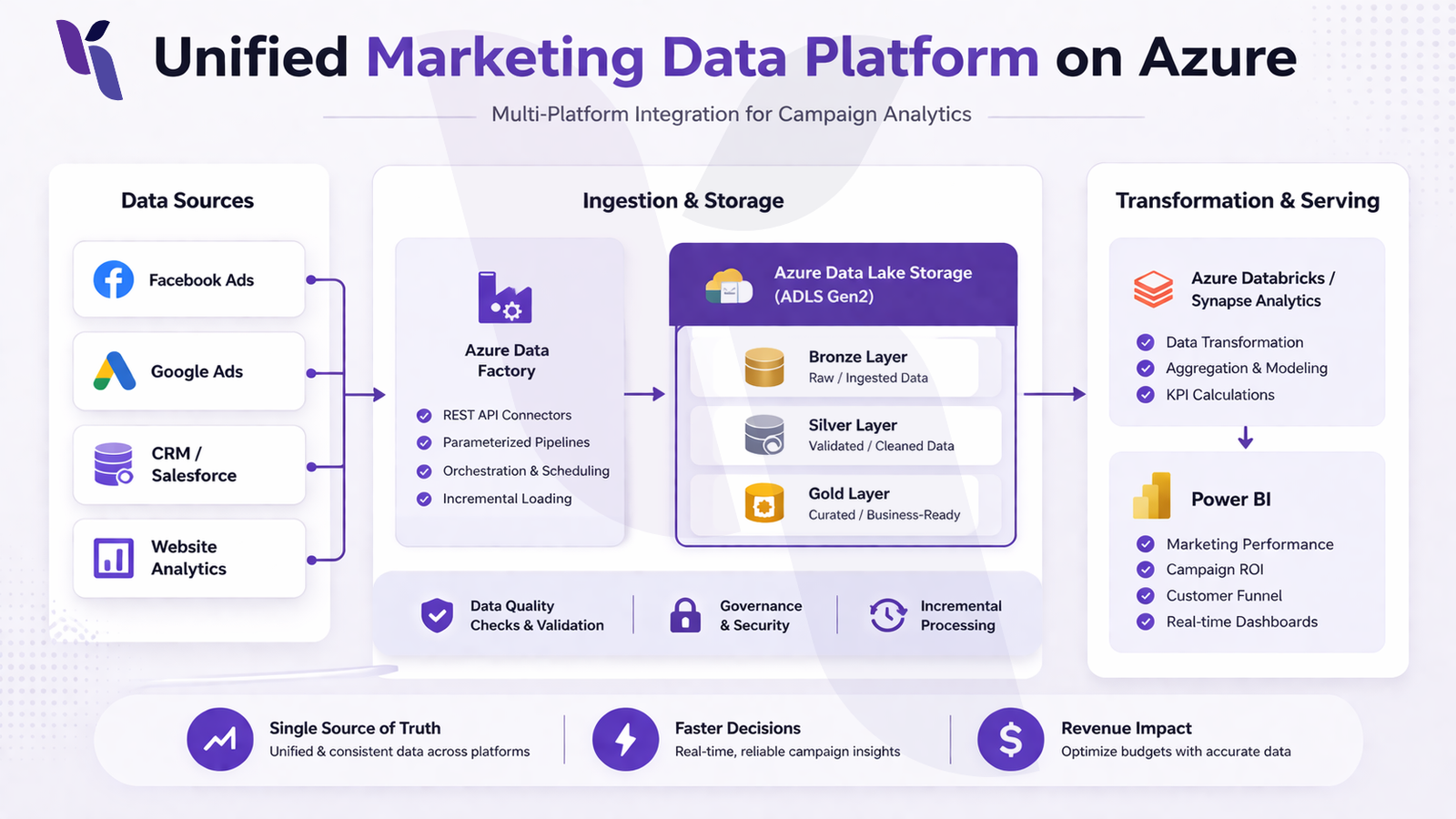
Instead of patching reports, the focus shifted to building a system that could support reliable decision-making at scale — using Azure’s modern data stack across three distinct layers.
Data Ingestion (Foundation Layer)
All API-based sources were centralized using Azure Data Factory. Historical data was loaded once; ongoing updates handled incrementally. This ensured performance didn’t degrade as data volume scaled.
Raw Data Layer (Bronze)
All data was stored in Azure Data Lake exactly as it arrived — no transformations, no assumptions. Only metadata like timestamps and source identifiers was added. This created a reliable fallback point for debugging and validation
Transformation Layer (Silver)
The real alignment happened here. Schemas were standardized, naming conventions aligned, duplicates removed, and missing values resolved using actual business context. The goal wasn’t perfection — it was consistency, because consistent data is what enables confident decisions.
Analytics Layer (Gold)
Unified datasets were built for campaign performance, customer funnel tracking, and key KPIs. For the first time, the system could clearly answer which campaigns drove actual revenue, where users dropped off, and how budgets should be reallocated.
Incremental Processing (Scalability)
Full reprocessing was replaced with watermark-based logic that targeted only new and updated records. Pipelines became faster and more cost-efficient — without sacrificing accuracy as data volumes grew.
Performance Optimization
Large datasets were partitioned, data models simplified, and unnecessary transformations removed. This allowed Power BI to deliver fast, reliable insights without heavy processing overhead.
Before vs. after
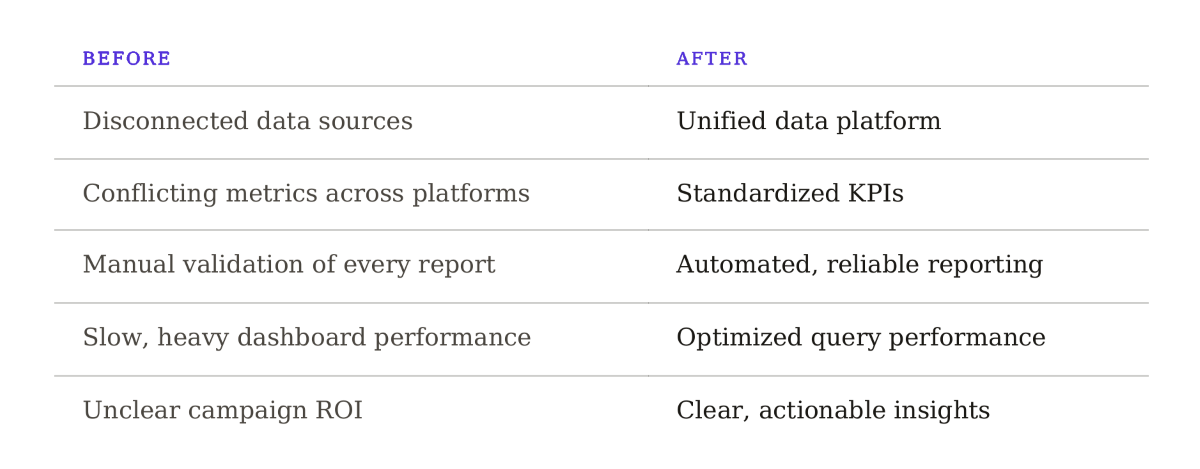
From Fragmented to Unified
impact Delivered
The Biggest Shift Was How Decisions Were Made
Instead of questioning the numbers, teams could focus entirely on optimizing performance. The data foundation enabled a fundamentally different way of working.
Key Insight
Marketing data doesn’t break because tools are missing. It breaks because systems evolve independently, data structures fall out of alignment, and growth outpaces architecture.
In fast-moving e-commerce environments, unreliable data doesn’t just slow decisions — it leads directly to missed revenue opportunities.
Fixing marketing analytics isn’t about better dashboards.
It’s about building a system where data is connected, consistent, and scalable.